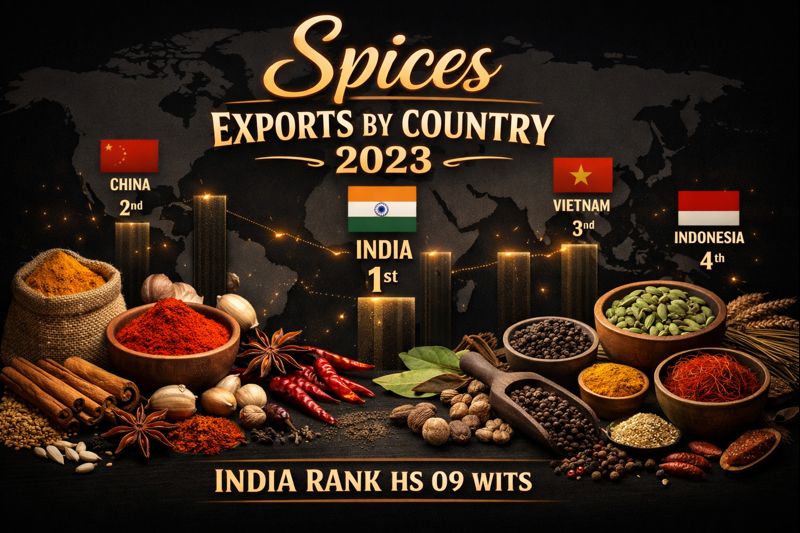
Spices—aromatic seeds, barks, roots, and fruits used for flavour, colour, and health benefits—are fundamental to culinary traditions worldwide. As global demand continues to grow, the international spice trade has become an essential segment of agricultural exports. The Harmonized System (HS) chapter 09 covers these products, including dried spices and “spice mixtures.” This comprehensive article explores 2023’s global spice exports by country, with a specific focus on India’s rank and performance under HS 09 categories, drawing on data from the World Integrated Trade Solution (WITS) and global export analysis.
Introduction to Global Spice Exports
Spices have transcended their origins as luxury goods to become indispensable everyday ingredients. Global spice exports include a broad array of products—from raw dried spices like turmeric and cumin to blended spice mixtures used in processed foods. The worldwide market has shown robust growth, spurred by expanding global food industries, rising consumer interest in exotic cuisines, and increasing awareness of spices’ health benefits.
According to export statistics, worldwide spice exports (including ground and crushed forms) were valued at several billion dollars in recent years, with top products such as peppercorn, spice mixtures, turmeric, and saffron commanding significant revenue shares.
Understanding the HS System and WITS Data
The Harmonized System (HS) is an internationally standardized system of names and numbers for classifying traded products. HS chapter 09 includes items such as:
- 086–091: Cereals, flour, and related products
- 0910: Ginger, saffron, turmeric, thyme, bay leaves, curry, and other spices
- Within that, subheadings like 091091 (Spice mixtures) and 091099 (Other spices, not elsewhere specified) are important for understanding specific trade flows.
The World Integrated Trade Solution (WITS) provides detailed export data, including trade values and shipment quantities by HS code, enabling precise analysis of each country’s performance.
Global Export Leaders in Spice Mixtures (HS 091091)
Under HS 091091, which includes mixed spices packaged for culinary use, the top exporting countries in 2023 were:
- India — $99.8 million (27.0 million kg)
- European Union — $84.8 million (15.0 million kg)
- Pakistan — $75.7 million (12.5 million kg)
- Netherlands — $71.5 million (16.3 million kg)
- Germany — $66.0 million (8.95 million kg)
- China — $32.7 million (2.5 million kg)
- Spain — $29.3 million (6.7 million kg)
- Austria — $22.8 million (2.19 million kg)
These figures show that India led the world in spice mixtures exports in terms of total export value, highlighting its strength in both raw and blended spice products.
Global Export Leaders in “Other Spices” (HS 091099)
The HS 091099 category encompasses spices not included elsewhere, from dried seeds to roots and barks. Top exporters in 2023 were:
- India — $128.9 million (83.33 million kg)
- Turkey — $126.0 million (39.9 million kg)
- South Africa — $59.3 million (20.45 million kg)
- European Union — $46.5 million (5.59 million kg)
- China — $40.4 million (3.96 million kg)
- United States — $39.4 million (7.41 million kg)
- Germany — $33.8 million (4.53 million kg)
Once again, India ranked first in export value and quantity, underscoring its dominance in both combined and miscellaneous spice exports.
India’s Position in Global Spice Exports
India: The World’s Leading Spice Exporter
India is widely recognized as the largest producer and exporter of spices globally. It holds a unique position due to its vast agro-climatic diversity, expansive cultivation of spice varieties, and deep-rooted cultural association with spice production. During the 2023–24 fiscal year, India’s total spice exports were estimated at approximately USD 3.73 billion, with continued growth into 2024–25.
This global leadership is not limited to overall export value; India also leads in several core spice categories and subcategories under HS 09. Key statistics include:
- India was the top exporter of spice mixtures (HS 091091) by value in 2023.
- India also led exports in other spices (HS 091099), with higher export value and volume than any other country.
Major Export Destinations
India’s spice exports reach over 200 countries worldwide. The major markets include:
- Middle East: United Arab Emirates, Saudi Arabia
- North America: United States, Canada
- Africa: Nigeria, South Africa
- Europe: United Kingdom, Germany
For instance, India’s spice mixtures export map shows significant shipments to the UAE, USA, Saudi Arabia, Nigeria, and the UK.
Product-Specific Leadership
India’s spice export strength is not just broad but deep. Leading spices by value include:
- Chilli (red pepper) — often India’s top export by value.
- Cumin (Jeera) and oleoresins — significant contributors.
- Turmeric and mint products — important value-adders in global markets.
These products increasingly find their way into global food processing, nutraceuticals, and specialty spice markets, making India indispensable in the global supply chain.
Comparative Global Export Trends
Several global analyses further affirm India’s dominant role in spice exports:
- According to another dataset, India accounted for approximately 37.24% of the global spice export market in 2023 (around USD 3.9 billion). Other top exporters included Vietnam (~28.1%) and Mexico (~9.6%).
- India’s exports far surpass those of other countries such as Turkey, Pakistan, South Africa, and China in both value and volume under the broader HS 09 categories.
The consistent global rankings across multiple datasets reinforce India’s position as the lead exporter of spices both in value and variety.
Factors Contributing to India’s Leadership
1. Diverse Spice Production Base
India boasts a wide array of spice-producing regions with diverse climates—from the tropical rainforests of Kerala to the semi-arid plains of Rajasthan and Gujarat. This enables the cultivation of a large variety of spices, including speciality products such as cardamom and cinnamon.
2. Established Trade Networks
Centuries of trade history have established Indian spices as trusted global exports. Long-term trade relationships with destinations in Asia, the Middle East, Africa, Europe, and North America create reliable markets for Indian exporters.
3. Government and Institutional Support
The Spices Board of India, along with trade facilitation bodies like APEDA (Agricultural and Processed Food Products Export Development Authority), supports exporters with quality standards, certifications, and market access initiatives.
4. Value-Added Processing
India not only exports raw spices but also processed and blended products tailored to international consumer preferences. This increases export value and market diversification.
Challenges in the Spice Export Sector
Despite its success, India’s spice export ecosystem faces challenges:
Quality and Safety Scrutiny
In recent years, certain Indian spice shipments have encountered increased scrutiny due to ethylene oxide residues, leading to regulatory challenges in markets such as Hong Kong, the UK, and others.
Authorities in multiple countries have tightened safety protocols on spice imports, prompting exporters to enhance testing and compliance mechanisms.
Global Competition
Countries like Turkey, Vietnam, and Mexico are growing their export footprints, particularly in specific spice niches, forcing Indian exporters to innovate and remain competitive.
Supply Chain and Climatic Challenges
Agricultural uncertainties like weather extremes and supply chain bottlenecks can affect crop yields and export consistency.
Future Outlook: India and Global Spice Trade
The global spice trade is projected to continue growing, driven by:
- Increasing demand for exotic and ethnic cuisines.
- Rising health-conscious consumption patterns.
- Growth in processed and packaged food sectors where spice blends are integral.
India, with its unmatched production base and established export networks, is poised to maintain leadership—potentially expanding into higher-value processed spice products and further diversifying export markets. Government ambitions target significantly higher export values by 2030, with continued emphasis on quality and value addition.
Conclusion
In 2023, under the HS 09 classification, India stood out as the world leader in spice exports, dominating in both spice mixtures (HS 091091) and other spices (HS 091099) categories by value and weight. With exports reaching into billions of dollars and a footprint across 200+ countries, India’s traditional spice economy continues to thrive in modern global markets. Yet, to sustain this edge, India must navigate quality standards, global competition, and evolving consumption trends.