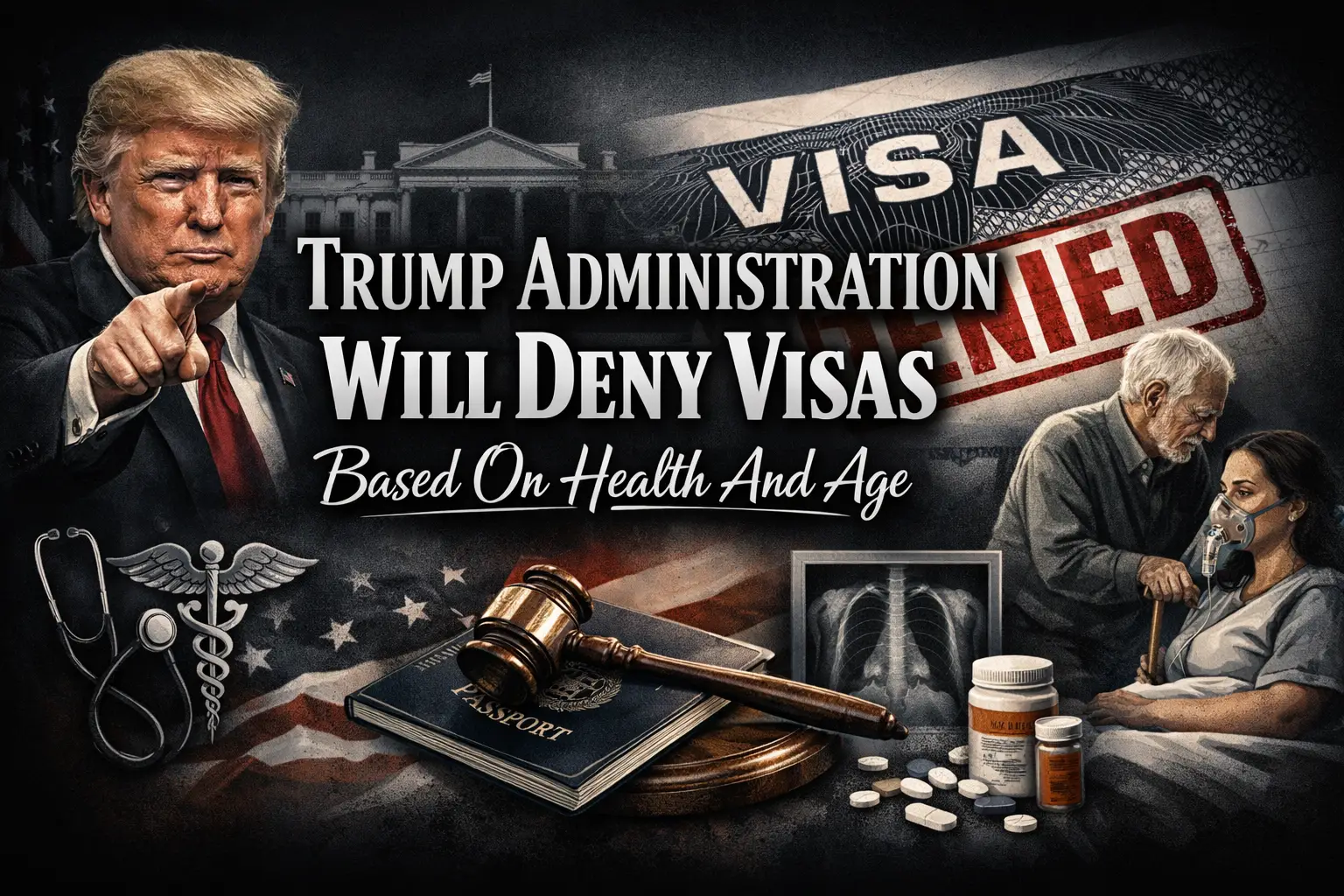
Immigration policy in the United States has long balanced national interests with humanitarian values, economic needs, and legal obligations. Few administrations have reshaped this balance as visibly or as controversially as the Trump administration. Among its most debated ideas and policy directions was the notion that visa applications could be denied based on an applicant’s health condition or age, particularly if those factors were perceived to increase the likelihood of becoming dependent on public assistance.
The idea that health and age could influence visa eligibility raised alarm among immigrant communities, policy analysts, employers, and human rights advocates. Supporters framed it as a rational effort to protect public resources and prioritize economic self-sufficiency. Critics viewed it as discriminatory, inconsistent with American values, and potentially unlawful under existing immigration and civil rights frameworks.
This article explores the background, legal foundations, policy rationale, and broader implications of denying visas based on health and age under the Trump administration. It also examines how such policies fit into the larger immigration system and what they mean for future visa applicants.
Historical Context: Health and Age in U.S. Immigration Law
The idea of considering health in immigration decisions is not new. Since the late 19th and early 20th centuries, U.S. immigration law has included health-related grounds of inadmissibility. Early immigration statutes barred individuals with certain contagious diseases, mental illnesses, or conditions perceived as rendering them unable to work.
Age, however, has traditionally played a more indirect role. U.S. immigration law does not explicitly prohibit entry based solely on age. Instead, age has often been considered in conjunction with employability, family relationships, or dependency. For example, employment-based visas naturally favor working-age adults, while family-based visas allow for children and elderly parents under specific sponsorship conditions.
The Trump administration’s approach did not invent health- or age-related scrutiny, but it sought to expand and more aggressively apply these considerations under broader policy frameworks such as “public charge” determinations.
The Public Charge Doctrine and Its Expansion
At the heart of the debate lies the concept of “public charge,” a long-standing principle in U.S. immigration law. Under the Immigration and Nationality Act, an individual may be denied a visa or permanent residency if they are deemed likely to become primarily dependent on the government for subsistence.
For decades, this doctrine was narrowly applied, focusing on cash assistance and long-term institutional care. During the Trump administration, however, the definition and application of public charge were significantly broadened. New rules proposed and implemented during this period considered factors such as age, health, family status, financial resources, education, and skills.
Under this framework, older applicants and those with chronic health conditions could be viewed as higher-risk candidates if they lacked private health insurance or substantial financial assets. While the policy did not impose an outright ban based solely on age or health, critics argued that it effectively created such barriers in practice.
Health as a Factor in Visa Decisions
Health considerations under the Trump administration went beyond communicable diseases. Applicants could be evaluated based on whether they had medical conditions requiring extensive or costly treatment, especially if they lacked health insurance or the financial means to cover care.
Supporters of this approach argued that it was fiscally responsible. They claimed that admitting individuals likely to incur high medical costs without adequate coverage could strain public healthcare systems and taxpayer-funded programs.
Opponents countered that this reasoning overlooked the complexity of healthcare economics and ignored the contributions immigrants make over time. Many immigrants with health conditions still work, pay taxes, and rely primarily on private or family support rather than public benefits.
There were also concerns about subjectivity. Medical conditions vary widely in severity, cost, and treatability, making it difficult to fairly predict future public benefit use. Critics warned that consular officers and immigration officials were being given excessive discretion without clear, consistent standards.
Age as an Implicit Barrier to Immigration
Age became a significant factor primarily because of how it intersected with economic productivity and healthcare costs. Older applicants were often presumed to be less employable and more likely to require medical care, especially if they were immigrating through family-based channels rather than employment-based visas.
The Trump administration emphasized “merit-based” immigration, prioritizing skills, education, and employability. In this framework, younger, working-age applicants were seen as more desirable, while elderly parents and relatives faced greater scrutiny.
Family reunification has historically been a cornerstone of U.S. immigration policy. Critics argued that policies disadvantaging older applicants undermined this principle and placed immigrant families in difficult moral and emotional positions, forcing them to choose between opportunity in the United States and caring for aging relatives.
Legal Authority and Constitutional Questions
One of the most contentious aspects of denying visas based on health and age was whether such practices were legally permissible. Immigration law grants the executive branch broad discretion in enforcing visa rules, particularly in the context of admissibility.
However, this discretion is not unlimited. Legal challenges argued that overly broad interpretations of public charge violated the Administrative Procedure Act and conflicted with congressional intent. Several courts temporarily blocked or limited aspects of the Trump-era public charge rules, citing procedural flaws and insufficient justification.
Age-based discrimination also raised constitutional and statutory concerns. While immigration law allows for certain distinctions, critics argued that using age as a de facto exclusion criterion could conflict with anti-discrimination principles, especially when not explicitly authorized by Congress.
Economic Arguments For and Against the Policy
Proponents of stricter health and age evaluations argued that immigration should maximize economic benefit. From this perspective, prioritizing younger, healthier immigrants with strong earning potential would increase tax revenues and reduce long-term public expenditures.
They also argued that the U.S. immigration system should be selective in a world of limited resources, ensuring that newcomers can support themselves and contribute to national prosperity.
Opponents challenged these assumptions. Numerous studies have shown that immigrants, including elderly family members, contribute economically in indirect ways such as childcare, household support, and enabling other family members to work more hours. Over time, immigrants as a group have been found to contribute more in taxes than they consume in benefits.
Critics also noted that economic value cannot be reduced to age or health status alone. Innovation, entrepreneurship, and community stability often arise from diverse, multigenerational immigrant families.
Humanitarian and Ethical Considerations
Beyond economics and legality, the policy raised profound ethical questions. Denying visas based on health conditions risked excluding individuals with disabilities, chronic illnesses, or genetic conditions, many of whom posed no public health risk and could live productive lives.
Human rights organizations argued that such policies stigmatized illness and aging, reinforcing harmful stereotypes. They warned that equating human worth with economic productivity eroded the moral foundations of immigration law.
Family separation was another major concern. Adult U.S. citizens and lawful permanent residents seeking to reunite with elderly parents faced the possibility of permanent separation if visas were denied on health or age grounds.
Impact on Different Visa Categories
The effects of health- and age-based scrutiny varied across visa types. Employment-based visas were less affected, as applicants typically had sponsors, jobs, and private insurance. Family-based visas, particularly for parents and other non-working relatives, faced greater obstacles.
Diversity visa applicants and refugees also expressed concern, fearing that health conditions or age could be used to deny entry even when humanitarian considerations traditionally played a stronger role.
Student visas were less directly impacted, but broader policy signals created uncertainty and fear, potentially discouraging applicants from countries with less robust healthcare systems.
International Perception and Diplomatic Consequences
U.S. immigration policy does not exist in a vacuum. The perception that visas could be denied based on health and age affected how the United States was viewed abroad. Some governments and international organizations criticized the approach as exclusionary and contrary to global human rights norms.
These perceptions had potential diplomatic consequences, influencing bilateral relations and the willingness of other countries to cooperate on migration, trade, and security issues.
Long-Term Implications for U.S. Immigration Policy
Although many Trump-era immigration policies were modified, reversed, or challenged after the administration ended, the underlying debate continues. The idea of tying immigration eligibility more closely to economic self-sufficiency, health status, and age remains influential in policy discussions.
Future administrations may revisit these concepts, potentially with different legal frameworks or safeguards. The challenge will be balancing fiscal responsibility with fairness, humanitarian values, and the recognition that immigrants are more than a sum of risk factors.
Conclusion: A Defining Debate Over Who Gets to Belong
The notion that the Trump administration would deny visas based on health and age reflects a broader philosophical shift in how immigration is understood. At its core, the debate asks whether immigration should prioritize economic efficiency above all else or continue to emphasize family unity, humanitarian protection, and diversity.
Health and age, while relevant in certain contexts, are deeply personal characteristics that intersect with dignity, equality, and human rights. Policies that elevate these factors risk excluding vulnerable populations and redefining national identity in narrow terms.
As immigration remains a central political and social issue in the United States, the legacy of the Trump administration’s approach serves as a cautionary and instructive example. It highlights the power of executive policy to reshape lives and the importance of ongoing public, legal, and ethical scrutiny in determining who is allowed to build a future in America.