Honey has a special place in Pakistani homes. We stir it into warm water on cold mornings, add it to desi kada when the weather turns, drizzle it over paratha, and gift jars of sidr honey to people we care about. But as demand for honey has grown, so has the number of products on the shelf that are not what the label claims. Syrup-diluted honey, over-heated honey and cheap blends sold at premium prices are a real problem for everyday buyers.
The good news is that you do not need a laboratory to become a smarter buyer. In this guide, we explain what pure honey actually is, walk you through simple home tests (and be honest about their limits), bust a few popular myths, and give you a practical checklist for buying honey in Pakistan.
Why Fake and Adulterated Honey Is So Common
Real honey is expensive to produce. Bees must visit a huge number of flowers, beekeepers must manage hives through all seasons, and the harvest depends on weather, flowering and location. A good sidr or wild Real honey harvest can be limited and costly.
That creates a temptation. Some sellers stretch honey with sugar syrup, glucose, corn syrup or jaggery (gur) syrup. Others feed bees sugar directly so they produce something that looks like honey but lacks the character of the real thing. Some honey is also heated and filtered so heavily that much of its natural aroma and character is lost. Then there is plain mislabeling: ordinary honey sold as rare “sidr” or “jungle” honey at a much higher price.
As a buyer, your goal is simple: reduce the risk of being fooled by combining careful observation, a few easy checks and, most importantly, a trustworthy source.
What Is Pure Honey?
Pure honey is the natural sweet substance made by bees from flower nectar. Nothing should be added to it and nothing important should be taken away. It naturally contains sugars (mainly fructose and glucose), a small amount of water, trace enzymes and plant compounds, and it has a distinct aroma depending on the flowers the bees visited.
This is why Pure Honey from different regions tastes different. Sidr (ber) honey, acacia (kikar or phulai) honey, mustard (sarson) honey and wild honey from northern areas each have their own colour, texture and flavour. If a jar tastes like plain sugar water regardless of what the label says, that is a warning sign.
An Important Note Before You Test
Home tests are only a rough guide. Some are quite unreliable, and clever adulteration can pass many of them. Think of them as a way to spot obviously poor honey, not as proof of purity. The only way to confirm purity with certainty is a lab test. Use several observations together rather than trusting a single trick.
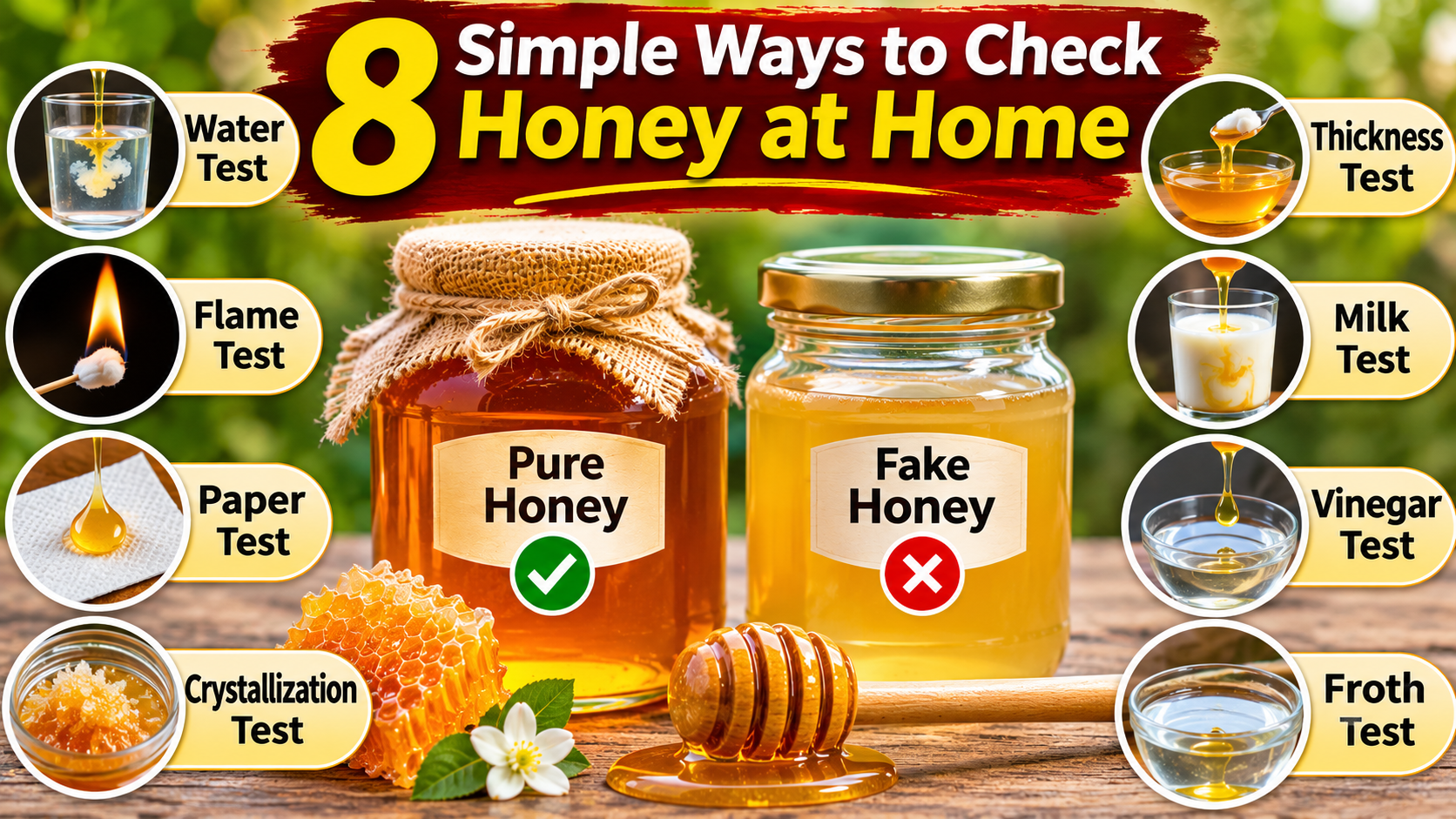
8 Simple Ways to Check Honey at Home
1. The Water Test
Fill a clear glass with room-temperature water and add a spoonful of honey without stirring. Thick, high-quality honey tends to sink in a lump and dissolve slowly. Honey that is diluted with syrup or has a high water content often starts spreading and dissolving quickly.
Limit: Thin but genuine honey (for example, honey harvested early with higher moisture) can also dissolve faster, so treat this as one clue only.
2. The Thumb Test
Place a small drop of honey on your thumb or fingertip. Thick, concentrated honey generally stays put and spreads slowly. Watery or diluted honey tends to run quickly.
Limit: Thickness depends on the honey type and temperature. Some real honeys are naturally thinner than others.
3. The Cotton Wick Test
Dip a dry cotton wick into honey, shake off the excess and try to light it. If honey is very low in moisture, the wick may burn steadily. If it crackles or refuses to burn, the honey may contain water.
Limit: This is not a scientific test, and fire is a hazard. Do it carefully, away from children, and do not treat the result as proof of anything.
4. The Bread Test
Spread a little honey on a slice of plain bread. Real honey generally stays thick on the surface, while diluted honey may soak into the bread faster. Again, this tells you more about moisture than about purity.
5. The Vinegar Test
Mix a spoonful of honey with a little water and a few drops of vinegar. Some people say foaming suggests adulteration with chalk or similar powders. This test only looks for one specific kind of cheating and says nothing about sugar syrup.
6. Look at Texture and Colour
Pure honey is usually smooth, thick and may show tiny natural particles such as pollen. It should not look like perfectly clear, odourless syrup. Colour varies widely: light honey can be golden, while sidr and wild honey are often darker. Colour alone is not a guarantee, but a very unnatural, uniformly clear look combined with no aroma deserves a second thought.
7. Smell and Taste
Open the jar and smell it. Real honey has a floral, warm, slightly woody or fruity aroma that depends on its source. Taste a small amount: you should notice complexity, with slight tang, sweetness and sometimes a mild warmth or bitterness at the back of the throat (sidr honey is known for a distinctive taste). If it tastes like flat sugar syrup, be careful.
8. Check the Label and Origin
This may be the most useful “test” of all. Look for the source or floral type, packing date, batch number, weight and seller details. Vague labels like “natural honey” with no information about origin deserve more questions.
The Biggest Myth: “Crystallized Honey Is Fake”
Many buyers throw away honey that has turned thick or grainy, believing it has been mixed with sugar. In most cases, it is the opposite. Crystallization is a natural process: honey contains more sugar than water can hold stable, and over time glucose can form crystals. Honey that crystallizes faster often has a higher glucose content, and cooler winter temperatures speed the process up.
So a jar that turns solid in winter is not automatically fake. In fact, some honey that never crystallizes at all may have been heavily processed or may simply be a type that crystallizes slowly (some varieties, like acacia, stay liquid longer). If your honey crystallizes, simply place the sealed jar in a bowl of warm (not boiling) water for a short time and stir gently. Avoid microwaving or overheating, which can damage its natural qualities.
What About Laboratory Tests?
If you buy honey in larger quantities, or you sell honey yourself, lab testing is the reliable way to judge purity and quality. Laboratories can check moisture content, sugar profile, signs of added syrups, and freshness and heat damage indicators. Genuine sellers who are confident in their product are usually happy to share test reports or explain how they source and pack their honey.
A Smart Buyer’s Checklist for Pakistan
Use this checklist the next time you buy honey, whether in a market or online:
- Be careful with very low prices. Real honey, especially sidr and wild honey, is costly. A suspiciously cheap “sidr honey” is a red flag.
- Ask where the honey comes from. A sincere seller can tell you the region and the flower source.
- Check the packaging. Look for batch details, packing date, net weight and clear contact information.
- Buy a small jar first. Test the taste, aroma and texture at home before placing a bigger order.
- Look for transparency. Sellers who answer your questions patiently and show real photos of their products are usually more trustworthy.
- Read honest reviews. Look for comments from real buyers, especially repeat customers.
- Do not rely on a single test. Combine observation, tasting, label checking and the seller’s reputation.
Popular Types of Honey in Pakistan
Knowing the main types helps you understand why prices and taste vary so much.
- Sidr (ber) honey: Valued for its rich taste and often the most expensive. It is widely sought after in Pakistan and the Gulf. Because it is in high demand, it is also one of the most commonly mislabeled honeys.
- Acacia (kikar/phulai) honey: Usually lighter in colour with a milder flavour, and available in many parts of Punjab and Sindh.
- Mustard (sarson) honey: Common in winter and spring, often light in colour and quick to crystallize.
- Wild or jungle honey: Collected from forests and mountain areas. Flavour and colour vary by season and location.
- Multiflower honey: A blend of nectar from many flowers, with a more varied taste.
Each has a different price, colour and texture, so do not expect all honey to look or taste the same.
How to Store Honey Properly
Good storage keeps honey in its best condition:
- Keep it in a tightly closed glass or food-grade container.
- Store it in a cool, dry place away from direct sunlight and heat.
- Always use a dry spoon, since water can encourage fermentation.
- You do not need to refrigerate honey. Cold temperatures only make it crystallize faster.
Well-stored honey can stay usable for a long time, though flavour and colour may slowly change.
Who Should Be Careful with Honey?
Honey is a food many families enjoy, but a few precautions matter:
- Never give honey to babies under 12 months old. It can carry a small risk of infant botulism.
- People with diabetes should talk to their doctor before including honey regularly, since it is still a form of sugar.
- Anyone with allergies to pollen or bee products should be cautious and consult a healthcare professional.
Honey is a traditional food and a sweetener, not a cure for diseases. If you have a medical condition, please speak to a qualified doctor.
Frequently Asked Questions
Is thick honey always real? Not always. Thickness depends on the type of honey, its moisture and the temperature. Some real honey is thin, and some fake products are made to look thick.
Does real honey ever spoil? Honey is naturally resistant to spoilage thanks to its low moisture, but it can ferment if water gets in. Store it sealed and use dry spoons.
Is darker honey better than lighter honey? No. Colour mostly reflects the flowers and minerals involved. Quality depends on purity, freshness and handling, not colour alone.
Can I trust the “ant test” or other online tricks? Most viral tricks are unreliable. Ants may even avoid some real honeys. Use common-sense observation and trusted sources instead.
Is raw honey the same as pure honey? Not necessarily. “Raw” usually means the honey has not been heavily heated or processed, while “pure” means nothing has been added. Ideally, you want honey that is both, from a source you trust.
Final Thoughts
Buying honey does not have to feel like a gamble. Simple checks such as the water test, the thumb test, smell, taste and label reading can help you avoid the most obvious poor-quality products, and understanding that crystallization is natural will save you from throwing away perfectly good honey. But the most reliable protection is a seller who is open about where the honey comes from and how it is packed.
At New Pansari, we believe customers deserve clear information about what they are buying. Explore our honey range and other natural products, and feel free to ask us about the source of any product before you order.
Disclaimer: This article is for general information only and is not medical advice. Consult a qualified healthcare professional about any health condition or before making changes to your diet.