Introduction
Masturbation is a sensitive subject that many people are reluctant to discuss. For someone who wants to stop masturbation, the challenge may involve much more than sexual desire. Pornography, social media, loneliness, boredom, stress, anxiety, staying awake late at night, and spending too much time alone with a smartphone can all become part of a repeated habit.
For Muslims, there can also be an important spiritual dimension. A person may want to quit masturbation because of Islamic teachings about chastity, modesty, and controlling sexual behavior. In that situation, the most useful approach is not simply to search for a “medicine to stop masturbation.” Instead, a person can combine Islamic guidance, behavioral changes, healthy lifestyle habits, and professional help when necessary.
Islam does not teach Muslims to despair because of their mistakes. Tawbah, sincere repentance, self-discipline, prayer, fasting, lowering the gaze, and avoiding situations that lead toward sin are important parts of the process.
From a medical perspective, masturbation itself is not automatically considered a disorder. However, if sexual behavior becomes difficult to control and causes significant problems in a person’s life, it may represent a compulsive pattern that deserves professional attention. Mayo Clinic describes compulsive sexual behavior as repeated sexual urges or behaviors that feel difficult to control and cause distress or problems in areas such as relationships, work, or health.
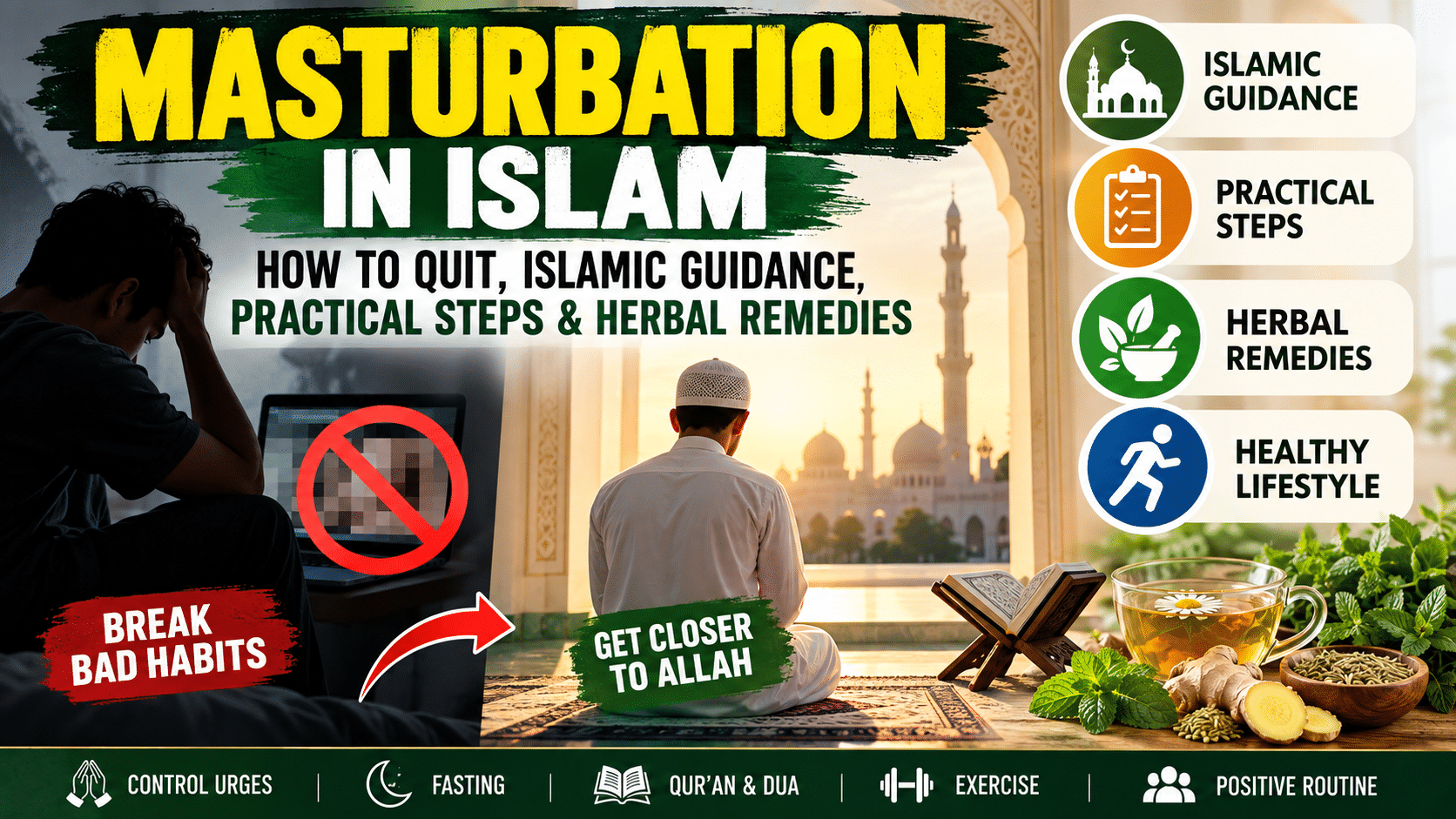
This article explains masturbation in Islam, how to quit masturbation, practical strategies for controlling urges, the role of fasting, pornography and trigger management, herbal remedies, and when professional help may be appropriate.
What Is Masturbation?

Masturbation means intentionally stimulating one’s own sexual organs for sexual pleasure.
Sexual desire itself is a normal part of human biology. Therefore, the objective for someone trying to quit masturbation should not necessarily be to eliminate every sexual thought or feeling. Instead, the goal can be to develop self-control and manage sexual desire in accordance with one’s religious values and personal goals.
For some people, masturbation may become connected with pornography or other sexually stimulating content. Repeated exposure to such material can make the habit more difficult to break.
A person may want to seek help if they notice patterns such as:
- Repeated unsuccessful attempts to stop
- Spending excessive time thinking about sexual activity
- Using masturbation to escape stress, loneliness, anxiety, or boredom
- Regular pornography use
- Feeling unable to control sexual urges
- Continuing despite significant personal or relationship problems
- The behavior interfering with work, studies, worship, sleep, or daily responsibilities
These are more relevant indicators of a problematic or compulsive pattern than simply counting how frequently someone masturbates.
Masturbation in Islam
Islam places considerable emphasis on chastity, modesty, lowering the gaze, and controlling sexual behavior.
There is some scholarly disagreement about the precise ruling on masturbation in different circumstances, but many Islamic scholars consider it impermissible. A Muslim who follows this position and wants to leave the habit can approach the issue through sincere repentance and practical self-discipline.
The Qur’an describes believers as those who guard their private parts except within lawful relationships in Surah Al-Mu’minun 23:5–7.
The broader Islamic principle is therefore to protect one’s chastity and avoid sexual behavior outside the lawful framework.
It is also important not to turn the subject into hopelessness. A person who has committed a sin can sincerely repent and continue working toward improvement.
What Did the Prophet ﷺ Recommend for Sexual Desire?
One of the most relevant teachings comes from the Prophet Muhammad ﷺ.
In Sahih al-Bukhari 5066, the Prophet ﷺ advised young people who were able to marry to marry, and those who were unable to marry to fast, because fasting was described as a means of controlling sexual desire.
This provides an important Islamic framework:
Marriage → when a person is able
Fasting → when marriage is not currently possible
Lowering the gaze → avoiding sexual stimulation
Chastity → protecting oneself from prohibited behavior
Therefore, someone who wants to quit masturbation can combine these principles with practical changes to their environment.
How to Quit Masturbation According to Islam
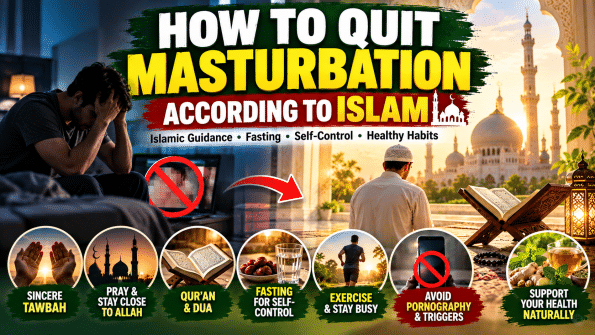
1. Start With Sincere Tawbah
The first step is sincere tawbah.
A person should:
- Stop the behavior.
- Feel genuine regret.
- Ask Allah for forgiveness.
- Make a sincere intention not to return to it.
- Take practical steps to avoid the circumstances that lead to it.
Tawbah should not be treated as merely saying words while continuing exactly the same routine. Real change also involves changing the habits and circumstances that repeatedly lead to the behavior.
If someone falls again, they should not assume that all hope is lost. They can repent again, identify what caused the relapse, and continue working toward improvement.
2. Lower Your Gaze
One of the most important practical steps is controlling what you look at.
Today, sexual stimulation can be available constantly through:
- TikTok
- YouTube
- Short-video platforms
- Websites
- Pornography
- Certain television or streaming content
A person who seriously wants to quit should remove unnecessary triggers.
Consider:
- Unfollowing sexually stimulating accounts
- Deleting saved explicit material
- Blocking pornography websites
- Using appropriate content filters
- Avoiding accounts that repeatedly trigger sexual thoughts
- Not browsing social media when alone in bed
Reducing access to triggering sexual material is also consistent with behavioral approaches used for compulsive sexual behavior. Mayo Clinic recommends identifying triggers and making access to pornography and problematic sexual content more difficult.
3. Use Fasting
Fasting is particularly relevant from an Islamic perspective because the Prophet ﷺ specifically recommended it for people who were unable to marry.
Fasting can also provide an opportunity to develop:
- Self-discipline
- Patience
- Control over impulses
- Greater awareness of one’s behavior
- Spiritual focus
A person should follow established Islamic guidance regarding voluntary fasting and should not fast in a way that harms their health.
Fasting should be considered part of a broader spiritual and lifestyle strategy rather than a guaranteed medical treatment.
4. Identify Your Masturbation Triggers
One of the biggest mistakes people make is trying to fight the behavior without understanding why it happens.
Ask yourself:
When does the urge usually appear?
Is it:
- Late at night?
- When you are alone?
- When you are bored?
- After watching social media?
- After viewing pornography?
- When you feel stressed?
- When you cannot sleep?
- When you are emotionally upset?
Write down the situations that repeatedly precede the behavior.
Once you know the trigger, you can change the environment.
For example, if the habit usually occurs when you lie in bed with your smartphone at midnight, move the phone away from your bed and establish a fixed bedtime.
Mayo Clinic similarly recommends identifying the situations, thoughts, and emotions that trigger compulsive sexual behavior.
5. Change Your Environment When an Urge Appears
When a strong urge appears, do not remain in the same environment and simply hope that the feeling disappears.
Immediately change your activity.
You could:
- Get out of bed.
- Perform wudu.
- Pray two rak’ahs.
- Read Qur’an.
- Go for a walk.
- Exercise.
- Sit with family.
- Move to a public area of your home.
- Start a productive task.
- Put your phone away.
The objective is to interrupt the automatic sequence:
Trigger → sexual stimulation → urge → masturbation
Instead, create a new sequence:
Trigger → recognize it → change environment → healthy activity → urge decreases
6. Avoid Pornography
For many people, pornography is a major trigger.
If pornography is part of the problem, quitting masturbation while continuing to consume explicit content can make the process much more difficult.
Consider removing:
- Pornographic websites
- Explicit videos
- Sexual photographs
- Saved files
- Triggering social-media accounts
- Private browsing habits that repeatedly lead to explicit material
Use website blockers if necessary.
This is not only a religious strategy; creating barriers between a person and triggering material is also recommended as part of managing compulsive sexual behavior.
7. Exercise and Stay Busy

Boredom and excessive free time can contribute to repetitive habits.
Create a daily routine that includes:
- Walking
- Running
- Cycling
- Strength training
- Sports
- Work
- Study
- Outdoor activities
- Family time
- Reading
- Productive hobbies
Exercise should not be described as a religious “cure” for masturbation, but it can provide a healthier way to manage stress and structure your day.
Mayo Clinic also recommends healthy outlets such as exercise and recreational activities for people dealing with compulsive sexual behavior.
8. Fix Your Nighttime Routine
For many people, late night is the most vulnerable period.
Try this routine:
After Isha → reduce unnecessary phone use → avoid explicit content → prepare for sleep → keep phone away from bed → sleep at a consistent time.
Avoid lying awake for hours while browsing the internet.
If you are not using your phone as a trigger, you have already removed one important opportunity for the habit.
Herbal Remedies for Masturbation
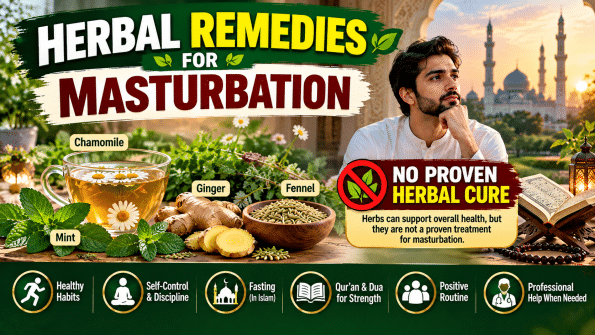
This is an area where health websites should be particularly careful.
There is no established herbal remedy that permanently cures masturbation.
Masturbation is a behavior, not a vitamin deficiency or a simple herbal deficiency. Therefore, taking an herb does not automatically eliminate the underlying behavioral triggers.
NCCIH states that no complementary health approach has been demonstrated to be safe and effective for sexual enhancement or treating erectile dysfunction, and research on individual herbal products is often limited.
This does not mean that all herbs are useless. It means that herbal products should be discussed honestly according to the evidence available for their specific purpose.
Can Herbs Help With Stress or Sleep?
Some herbal beverages are traditionally used as part of relaxation or bedtime routines.
For example:
Chamomile
Chamomile is commonly consumed as a relaxing herbal tea. It should not be advertised as a cure for masturbation.
Peppermint
Peppermint tea can be used as a caffeine-free beverage and may fit into a healthy evening routine.
Ginger
Ginger is widely used as a food and traditional herbal ingredient. It should not be marketed as a medicine that stops sexual urges.
Fennel
Fennel is commonly used as a culinary and traditional herbal ingredient. There is not sufficient evidence to claim that fennel cures masturbation.
The important distinction is:
Herbal tea for general wellness ≠ herbal cure for masturbation.
Be Careful With “Sexual Control” Herbal Products
Some products online make claims such as:
- “100% masturbation cure”
- “Permanent sexual weakness treatment”
- “Stop sexual desire instantly”
- “Guaranteed anti-masturbation formula”
- “Reduce sexual urges permanently”
- “Cure masturbation addiction naturally”
These claims should be treated with caution.
NCCIH warns that supplements marketed for sexual enhancement can have safety problems, including undisclosed pharmaceutical ingredients, contamination, excessive doses, and interactions with prescription medications.
NCCIH also emphasizes that “natural” does not automatically mean safe and that supplements can interact with medicines or contain ingredients that are not listed on the label.
Therefore, someone should not take an unknown herbal product simply because it claims to eliminate sexual desire.
What About Testosterone and Sexual Desire?
Another common misconception is that a person must completely suppress testosterone or eliminate sexual desire to stop masturbation.
That is not the goal.
Sexual desire is a normal physiological function. The healthier objective is learning to control behavior and respond to sexual urges appropriately.
A person does not need to eliminate normal hormones to develop self-control.
If someone believes they have a hormone problem, erectile dysfunction, abnormal libido, or another medical issue, they should speak with a qualified healthcare professional rather than attempting to alter hormones using unregulated herbal products.
What If You Masturbate Again After Trying to Quit?
A relapse does not mean that your entire effort was meaningless.
Instead of thinking:
“I failed, so I might as well continue.”
Ask:
“What caused the relapse?”
Maybe the trigger was:
- Pornography
- Loneliness
- Stress
- Staying awake late
- Social media
- Being alone
- Boredom
- Emotional distress
Write down the trigger and modify your plan.
Recovery from compulsive behavior can take time. Mayo Clinic notes that setbacks can occur and that ongoing treatment and support may help prevent relapse.
From an Islamic perspective, a person should continue to seek Allah’s forgiveness rather than allowing guilt to turn into hopelessness.
A 30-Day Islamic Plan to Quit Masturbation
Days 1–7: Remove Triggers
During the first week:
- Delete pornography.
- Unfollow triggering accounts.
- Install content filters.
- Stop using your phone in bed.
- Identify your strongest triggers.
- Maintain your five daily prayers.
- Begin a consistent sleep schedule.
- Keep yourself occupied.
The goal is to make the old habit more difficult to access.
Days 8–14: Build Discipline
During the second week:
- Continue avoiding pornography.
- Exercise regularly.
- Spend less time alone when vulnerable.
- Consider voluntary fasting if appropriate for you.
- Increase Qur’an reading.
- Reduce unnecessary social-media use.
- Establish a productive daily schedule.
This stage is about replacing the old routine with healthier habits.
Days 15–21: Strengthen Self-Control
Now focus on recognizing urges before they become overwhelming.
When an urge appears:
Stop → recognize → change location → perform wudu → pray or engage in another activity → allow the urge to pass.
Don’t sit alone repeatedly thinking about the urge.
Days 22–30: Maintain the New Lifestyle
By this stage, continue:
- Prayer
- Qur’an
- Fasting where appropriate
- Exercise
- Healthy sleep
- Avoiding pornography
- Limiting triggering social media
- Staying productive
- Spending positive time with family and friends
The objective is not simply to complete 30 days. It is to develop a lifestyle that makes the behavior easier to control over the long term.
When Should You See a Doctor or Therapist?
Professional help can be appropriate if:
- You repeatedly try to stop but cannot.
- The behavior consumes a significant amount of your time.
- Pornography has become difficult to control.
- It interferes with work or studies.
- It affects relationships.
- You experience severe anxiety or depression.
- You feel that sexual urges are completely outside your control.
Mayo Clinic describes several therapeutic approaches for compulsive sexual behavior, including cognitive behavioral therapy (CBT), acceptance and commitment therapy, mindfulness-based approaches, and other forms of psychotherapy. These approaches can help people identify triggers and develop healthier responses to urges.
Seeking professional help does not prevent someone from following Islamic principles. A person can pursue appropriate psychological or medical treatment while maintaining their religious values.
Islamic and Natural Approach: The Complete Strategy
For someone who wants to quit masturbation, think of the process as several connected areas:
Spiritual
- Salah
- Tawbah
- Qur’an
- Dua
- Fasting
- Lowering the gaze
Behavioral
- Remove pornography
- Identify triggers
- Change your environment
- Create barriers to explicit content
- Develop replacement activities
Lifestyle
- Exercise
- Sleep properly
- Stay productive
- Reduce excessive social-media use
- Spend healthy time with family and friends
Professional
If the behavior becomes compulsive or severely affects your life, consider speaking with a qualified healthcare or mental-health professional.
Herbal
Herbal products may be part of general wellness when used appropriately, but there is no proven herbal cure for masturbation. Avoid exaggerated claims and unverified sexual-health supplements.
Frequently Asked Questions
Is masturbation haram in Islam?
Many Islamic scholars consider masturbation impermissible, although there are differences of scholarly opinion concerning particular circumstances. A person seeking a religious ruling for their specific situation should consult a trusted qualified scholar.
How can I stop masturbation permanently?
There is no guaranteed instant method. The practical approach is to identify triggers, remove pornography, change routines, develop self-control, use Islamic practices such as fasting, and seek professional help if the behavior is compulsive.
Does fasting help control sexual desire?
The Prophet Muhammad ﷺ advised young people who were unable to marry to fast as a means of controlling sexual desire. Mayo
Is there an herbal medicine that cures masturbation?
There is no established herbal medicine proven to permanently cure masturbation. Be cautious of products making guaranteed claims.
Can pornography make quitting harder?
For people whose masturbation is triggered by pornography, continued exposure can reinforce the habit. Removing access to pornography and other triggers can therefore be an important part of changing the behavior. Mayo Clinic
What should I do after a relapse?
Do not give up. Identify the trigger, repent according to your beliefs, modify your routine, and continue your recovery plan.
Conclusion
Quitting masturbation is not simply a matter of finding a particular herb or taking a supplement. For a Muslim who wants to leave the habit, a comprehensive approach can combine sincere tawbah, salah, fasting, lowering the gaze, avoiding pornography, controlling triggers, exercise, healthy sleep, productive activities, and marriage when a person is able.
The Prophet Muhammad ﷺ specifically recommended marriage for those who are able and fasting for those who are unable to marry as a means of controlling sexual desire.
Herbal remedies should be approached realistically. There is currently no scientifically established herb that permanently cures masturbation, and unverified sexual-enhancement supplements can carry significant safety risks.
The most important principle is to focus on self-control rather than eliminating normal sexual desire. If the behavior becomes compulsive and repeatedly interferes with everyday life, professional psychological support can be useful.
For someone sincerely trying to change, the process may take time. A setback does not have to become a permanent return to the old habit. Identify the cause, make the necessary changes, seek forgiveness, and continue moving forward.